
Why Partnering Is Required
More than a courtesy—a mandatory administrative requirement under federal specifications. Understand the governing directives, selection levels, and measurable returns for prime contractors.
The directives that govern partnering
Federal agencies enforce project partnering through explicit contractual specifications.
When a prime contractor signs a NAVFAC, USACE, or AFCEC contract, partnering is not an optional suggestion; it is a legally binding deliverable in the administrative specifications.
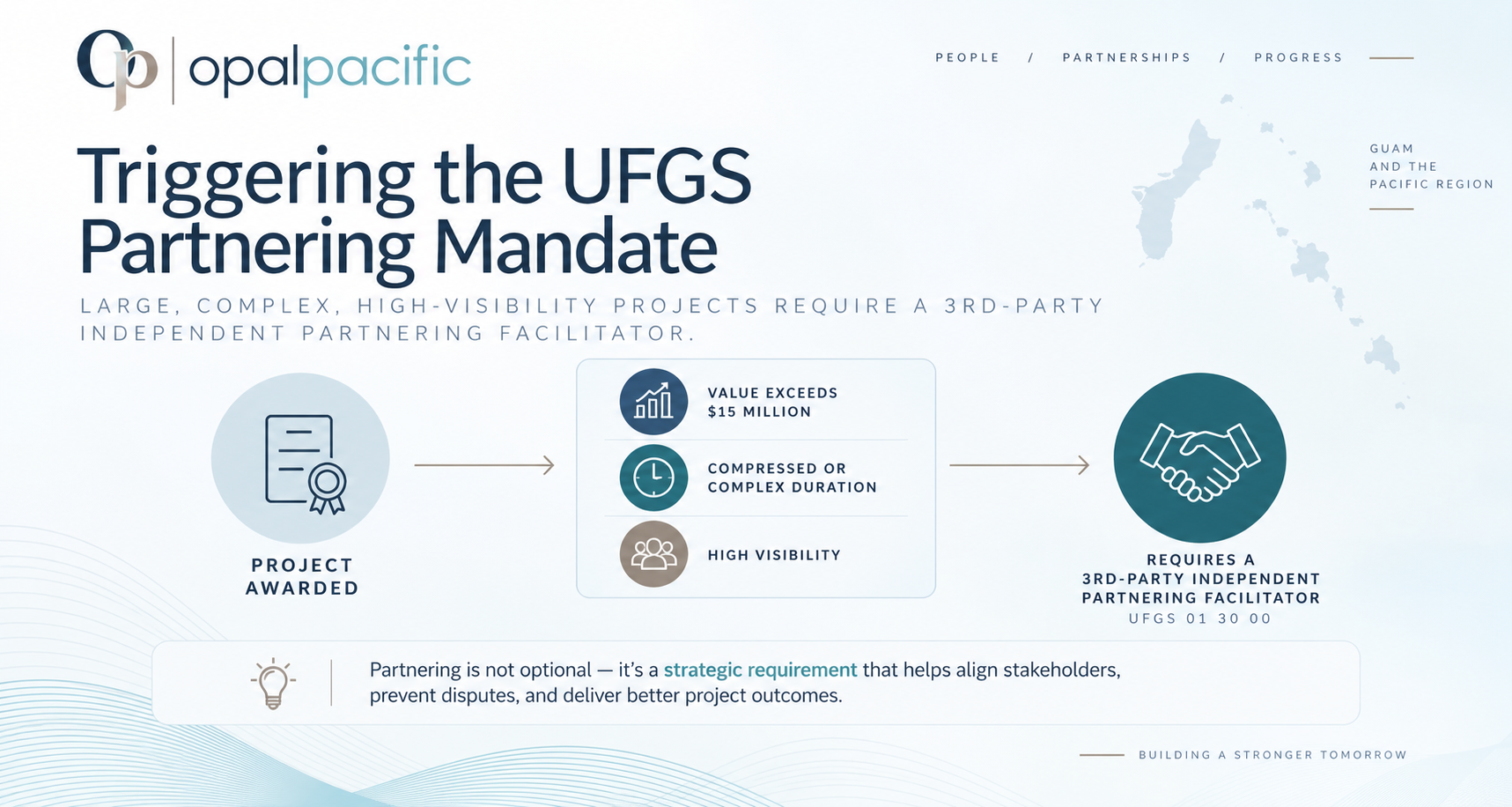
UFGS 01 30 00 — Section 1.11 (Partnering)
The Tri-Service Unified Facilities Guide Specification mandates that the initial partnering session be held within 35 calendar days of award and before work begins. On formal partnering projects, the prime contractor is responsible for retaining the independent facilitator and securing an off-base venue.
NAVFACINST 11013.40B — Facilities Construction
Directs Resident Officers in Charge of Construction (ROICC) and Facilities Engineering and Acquisition Divisions (FEAD) to institute formal partnering on high-complexity, high-visibility, and large-dollar capital improvement contracts across the Marianas.
USACE EP 34-1-1 & ECB 2006-14
The Army Corps Standardization Partnering Playbook sets strict standards for third-party neutral qualifications, team health surveys, shared risk registers, and time-bound issue escalation ladders across the project lifecycle.
Facility Support Contracts — Annex 0200000 §2.3.3
Base Operating Support (BOS) & Recurring MaintenanceGoverns military base operations, recurring maintenance, and facilities support service contracts. Mandates a cohesive operational partnership with the contractor and an Initial Informal Partnering Session scheduled concurrently with the Pre-Performance Conference — no later than 30 days after award — utilizing NAVFAC-provided digital media and forms.
Formal or informal? Selecting the partnering level
Contract specifications dictate whether your project requires Formal Partnering (with an independent neutral facilitator) or Informal Partnering.
Formal Partnering
Mandatory under UFGS 01 30 00 for projects exceeding $15M, complex multi-year scopes, compressed timelines, or high-visibility mission-critical assets.
- Facilitator: Neutral, independent professional retained by the prime contractor.
- Venue: Full-day off-base session at a neutral conference facility.
- Deliverables: Signed Partnering Charter, Issue Resolution Ladder, Risk Register, Quarterly Reviews.
Informal Partnering
Typically applied to projects under $15M, routine maintenance contracts, or straightforward single-trade scopes without high inter-agency coordination.
- Facilitator: Conducted internally by the Government Construction Manager and Prime PM.
- Venue: On-base or jobsite field trailer meeting concurrent with pre-con conference.
- Deliverables: Basic alignment protocol and contact hierarchy recorded in meeting minutes.
What a well-run partnering program returns
Research by the Construction Industry Institute (CII) demonstrates that collaborative partnering yields up to $98 in dispute savings for every $1 invested.
Contractual & Financial Benefits:
Accelerated submittal and RFI response cycles; substantial reduction in change order processing delays; total avoidance of liquidated damages; protection of contractor bid margins.
Operational & Human Benefits:
Replaces adversarial positioning with open problem-solving; aligns subcontractor superintendents with the prime's master schedule; establishes a direct, safe channel to resolve field frictions before they escalate.
The Partnering Toolkit
Every session facilitated by OPAL Pacific produces concrete, documented governance instruments that are filed directly into your official contract records.
Partnering Charter
Signed by every key stakeholder—Government, Prime, Designer, and Subcontractors. Defines shared goals, quality commitments, and safety targets.
Disputes Resolution Ladder
Defines designated individuals at field, PM, and executive rungs with strict, binding time limits (24h, 3 days, 7 days) to resolve disputes.
Issues & Risk Register
Identifies high-consequence project vulnerabilities, differing site conditions, long-lead procurement bottlenecks, and assigned mitigations.
Relationship Maintenance Plan
Schedules follow-on sessions at 3-to-6-month intervals and establishes quarterly team health assessment cadences across the contract duration.
Ready to fulfill your partnering mandate?
Our facilitators are badged, on-island in Hagåtña, and ready to coordinate your initial session within the required 35-day window.